The AI-native software company is not a better SaaS company. It is a different kind of business — with potential to transform customers and to change how their business is conducted. For the past decade, VC and tech buyout firms focused on Software as a Service (SaaS) could underwrite opportunities more like hedge funds trading names on statistics rather than a deep understanding of the underlying products. They focused on headline metrics such as Gross Retention, Net Retention and Growth Rates. They invented simplified terms like "Rule of 40" and "Magic Number" to imbue the rudimentary analytics with jargon that implied some level of expertise.
Software models are always changing. Cloud-based multi-tenant SaaS lowered the technology moat and widened adoption over the previous standard, customized on-premise software. In the latest software incarnation, AI-native solutions are virtually eliminating technology barriers for simple use cases with code-generation models and agents. Here the focus shifts from improving users' workflows with interfaces to actually performing work. But deploying autonomous systems in high stakes B2B application isn't as simple as to set a technology loop and forget it. A startup cannot "vibe code" its way to an enterprise-class application with its requirements for scalability, security and proprietary access requirements. Enterprise B2B AI-native applications requires active human participation, orchestration and judgement. The competitive barrier for applications is no longer grounded in technology but rather in subject matter expertise, in changing regulatory demands, in specialized and proprietary data sets and ultimately, in human judgement.
These elements which were undervalued in a cloud-centric market have become essential ingredients to AI-native software solutions. We believe therefore that services companies are better positioned than software companies to drive the transition to AI-native solutions because they are aligned and incentivized to expand into larger labor markets and to increase margins by up-skilling specialized workers with agents. Services companies are already embedded in their client's workflows and the best companies have the trust of their customers to increase productivity, protect secrets, connect disparate systems and empower human-in-the-loop controls to mitigate risk.
What has changed for legacy SaaS companies
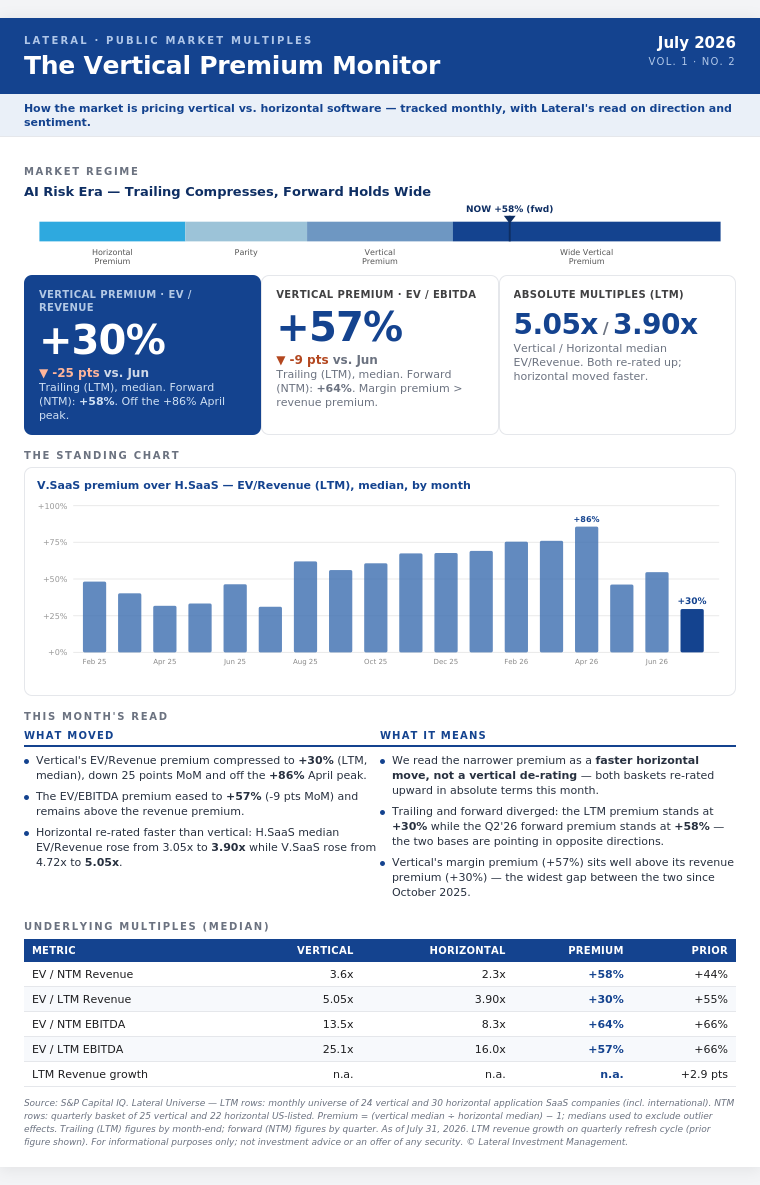
Legacy SaaS companies, especially horizontally focused incumbents like Salesforce and Workday, face numerous disruptions from the emerging AI-native market. Growth was already weakening. The on-premise to cloud software transition is in its twilight stages. Many SaaS companies don't know their customers particularly well. The bright line between SaaS and services is a major impediment to SaaS companies who have managed their clients at arms-length - outsourcing services and implementations as "bad revenues" to 3rd parties who actually manage there client relationships. Typical "customer success" metrics in SaaS gauge active usage of the software, not the customer's actual success in terms of goals and productivity. There's a misalignment between per-seat pricing that depends on the flourishing of knowledge worker budgets and the potential for AI to disrupt and replace knowledge worker jobs. Terminal values of SaaS companies are fundamentally threatened by this AI transformation. Many clients are oversold on seats. Headless agentic models require fewer seats rather than more seats. The capabilities and business models emerging on the other side are different enough that the old valuation instincts misfire on them. Some of the legacy players are poorly positioned to make the transition because they will have to cannibalize their core recurring revenue businesses. The next few articles are about Before any of the mechanics, it's worth being precise about what has actually changed: not the technology stack, but the unit the market is paying for.
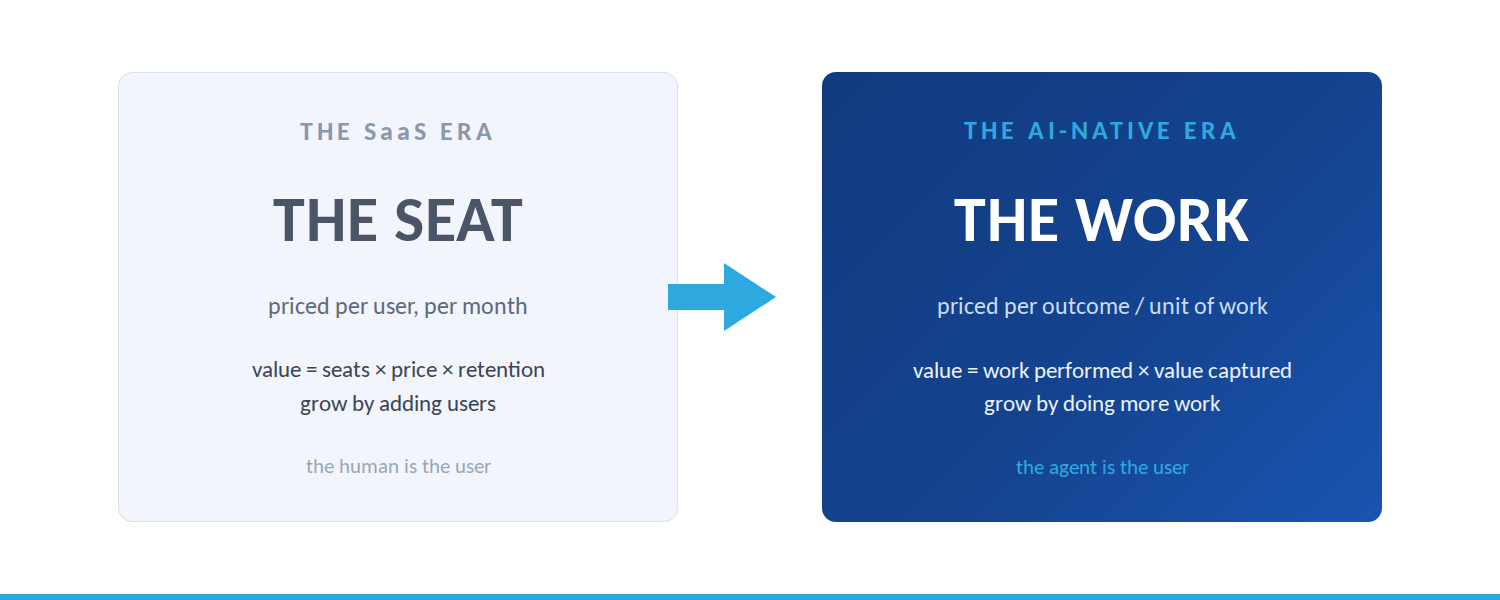
The unit the market uses to price for software is shifting from the seat to work.
What the market was really buying - predictable contractual revenues
The rich SaaS multiple was never a reward for a technology business with proprietary code. It was valued for its reliable revenue streams based on a financial contract: recurring monthly, highly retained, and expandable inside the account. The atomic unit was the seat — value equaled seats times price times retention — and the entire operating model optimized that unit. Land a customer, expand seats, push net revenue retention above 110%, and the market extrapolated the curve and paid 15 to 20 times revenues for the privilege. The captive customer base was the asset. The more "white collar" workers who logged in, and the more reliably they kept logging in, the more the business was worth. What the software by itself accomplished for the workers and for their employers was sometimes nebulous and difficult to measure. With the right training and implementation, the dashboards and analytics provided rapid feedback and visibility which armed managers to make better and more data-driven decisions.
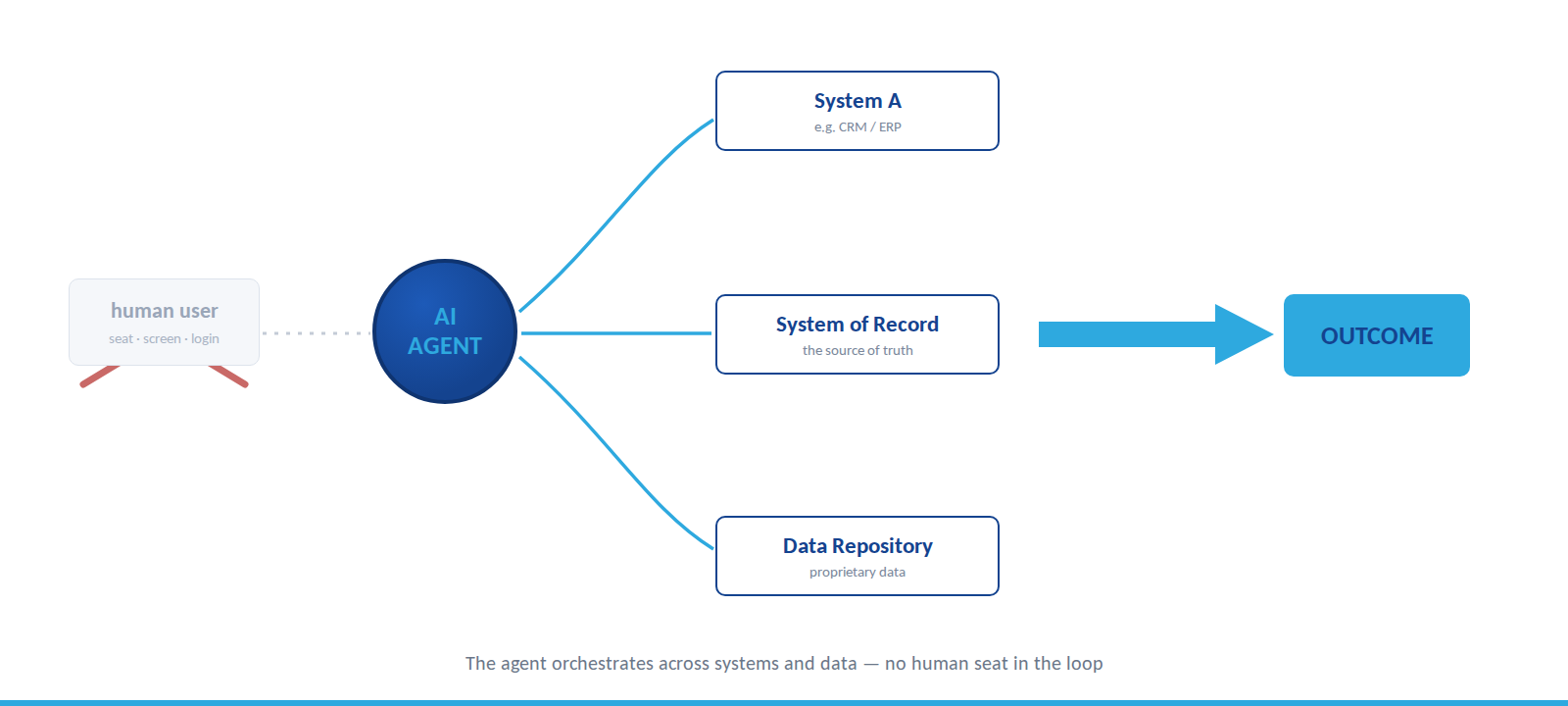
The seat was always a proxy. Software was priced per user because the user was the one doing the work; the license was really a charge for human access to a tool. Remove the human from the middle of the workflow — which is precisely what agents do — and the proxy comes apart. When an AI agent performs the task rather than assisting a person through it, usage stops tracking headcount. A sales operation that needed a hundred CRM licenses may need fifty; the work didn't shrink, the number of humans at screens did. The quantity the whole model was priced on is decoupling from the value being delivered, which is why revenue that once looked like an annuity has started to look like an open question.
How AI-native companies drive different results - outcomes, not workflow
If the seat is no longer the unit, what is? It is work performed - highly measurable, with a clear productivity ROI, that translates directly to value for customers. AI-native software doesn't just provide the tools for a person to complete a task faster (thought it can do that too); it can completes 90% of a routine task and allow the human to review for exceptions and judgement calls. That shift changes what is being sold — from information access to work outcomes — and those outcomes can be priced against the labor market. Enterprise software historically has competed for the IT budget, a few percent points of operating expense. Autonomous work competes for the labor budget: the $6–8 trillion annual knowledge worker market.
The new measure to evaluate AI-native opportunities is: how much work does the software actually perform, how defensibly does it perform it, and how much of the value it creates can it capture? A company that performs a great deal of valuable, hard-to-replicate work — and is paid a share of that value rather than a per-seat fee — is worth more than the SaaS model could ever have justified. The flip side is that a company that performs generic work AI models can fully replicate (e.g., paralegal work, project management software) is worth less than its predecessor, because the one thing it sold — coordinating human effort — is exactly what the agent now does for free.
The upside opportunity is a larger addressable market, more value per customer (a fraction of the labor replaced rather than a per-user fee), and deeper retention and embedding in the workflows of a business, because software that does the work is far harder to remove than software that merely organizes and measures it. But none of this is conferred by tacking "AI" onto the product with a chatbot interface. If the product is a thin layer over a model it captures none of the premium, because the model underneath it is commoditizing and the next wrapper will undercut it on price within a quarter.
Why services platforms are better positioned than SaaS or startups for B2B AI native opportunities
For startups, AI offers a path of creative destruction, to rebuild everything anew, which incumbents are usually slow to embrace because they have the most to lose. The problem is that AI platforms require widespread integration and adoption by users and data analysis and training with proprietary systems and data sets. The opportunity for startups is to meet the moment with pilots and tests to get the next round of funding. This works well with consumer and SMB buyers who are fickle and price-conscious early adopters. Not so much with Fortune 500 customers. While every corporate leader has an AI experimentation budget and a mandate to bring their business into the AI future, the high adoption of pilots with multiple competing solutions is only matched by low contract rates and growing concerns about token budgets. Startups work well in markets where point solutions can expand into platforms but the full potential of AI requires a broad-based solution. In many domains, the economics of standalone AI solutions scale into cost-prohibitive and unpredictable outcomes.
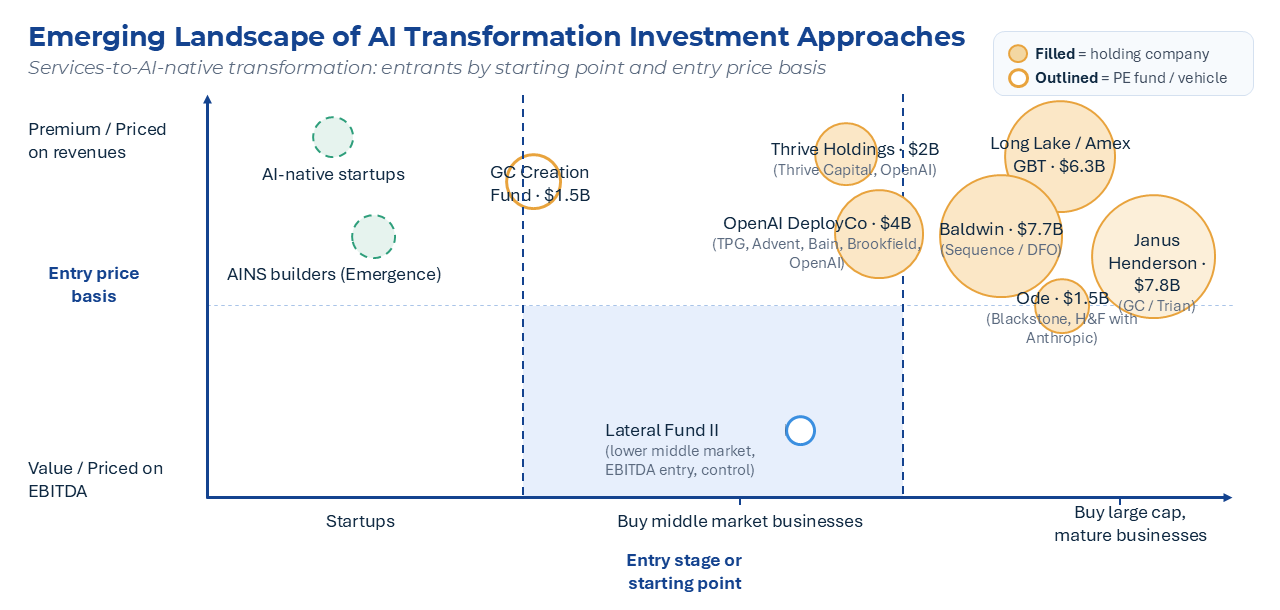
We see the better path in bringing AI-native solutions to the business market through existing and specialized, vertically focused service providers. Who knows the disparate systems and data assets better than the B2B services entities that manage them today. The knowledge worker economy has grown across regulated and information-based markets such as legal, banking, insurance, cybersecurity, general contracting, compliance and many other domains where highly educated workers operate assembly lines of value-added information chains that agentic systems can replicate more efficiently. What should be valued is the durability of the work performed: whether a specialized AI-native company can keep doing the work, accurately with human review, in a way a general-purpose model cannot replicate on its own. That durability has three sources — distribution through a recurring, longstanding customer base; domain expertise specialized to a regulated or complex industry; and proprietary data that drives decisions, is closely held by customers, and is inaccessible to frontier models. Those are the assets that convert "we use AI" into something worth paying for, something that is AI-native and could not have been produced in the previous cloud-native paradigm. Without these elements, an AI-native company is a feature waiting to be absorbed. With those elements, it is a business with the means to transform the productivity of an industry.