Ask most people which company wins the AI era and they'll name a model: OpenAI, Anthropic, Google. It's the obvious answer, and for the infrastructure layer it may even be right. But for the application layer which is the software businesses that actually sell to enterprises, it's the wrong question, and we believe that history shows that every technology cycle delivers long term value to applications companies.
The performance and functionality of premium frontier models are converging and are fast-followed by low-cost, open-source models. The gap between the best model and the second-best, and between the closed-model leaders and the open-weight and open-source pack, narrows with every release. That's the signal of a commoditizing service in a noisy bubble-distorted market, not a durable moat. If your product is the model or a thin wrapper around a specific model rather than an abstraction layer with defensible components you are building on shaky platform advantages that get more commoditized every quarter.
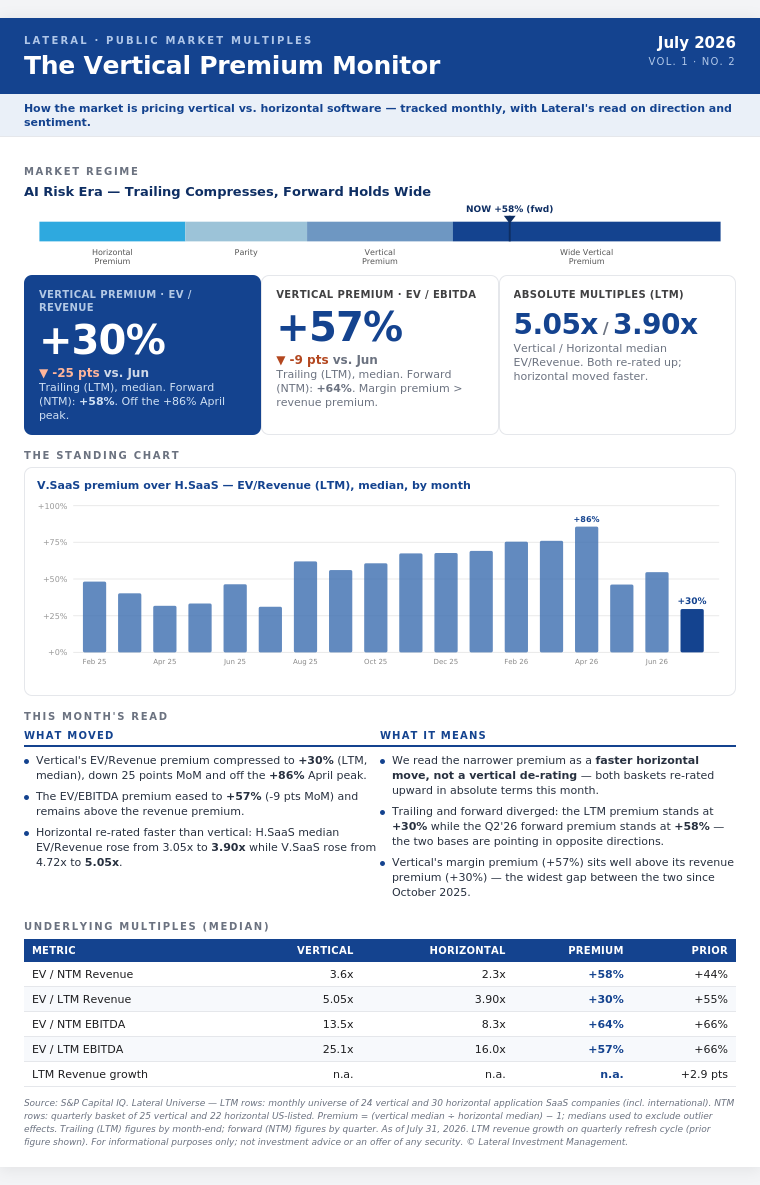
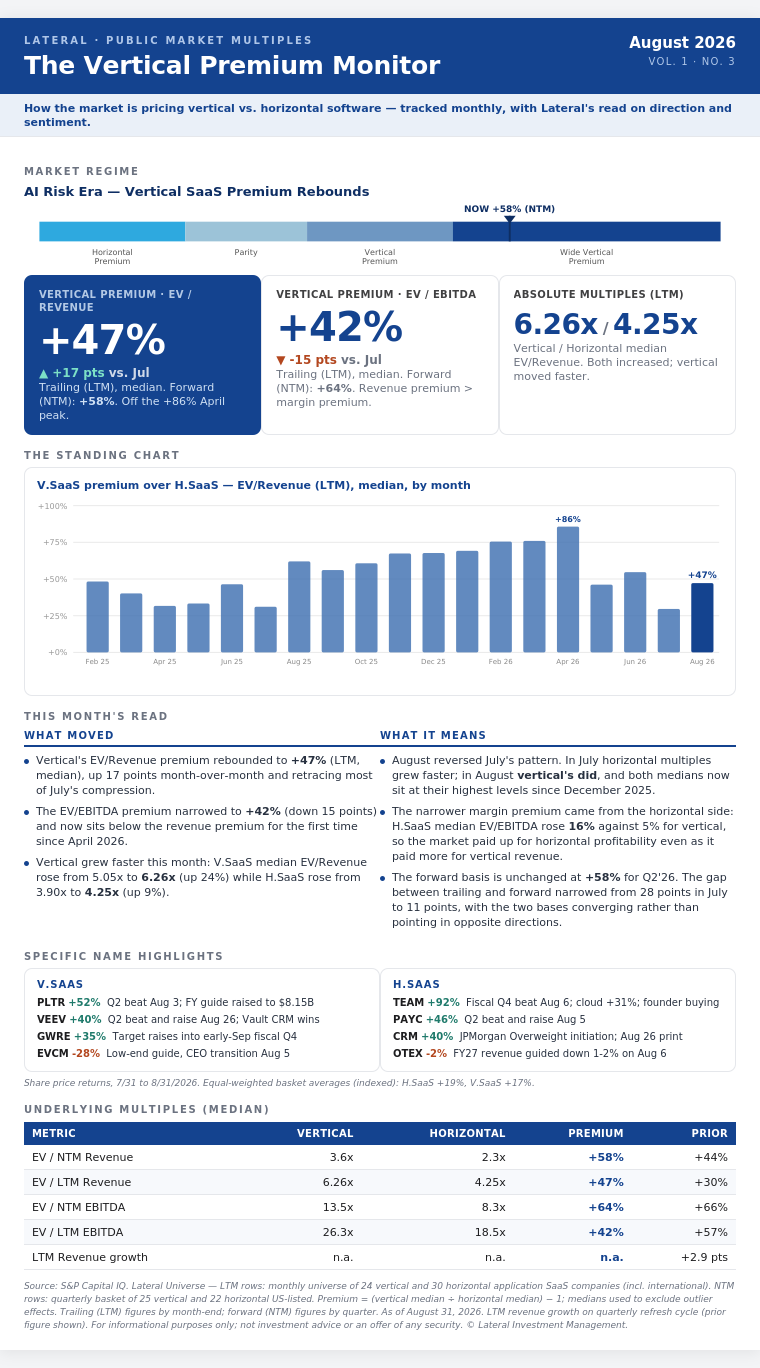
In the last post we discussed how the market now pays a 58% premium for vertical software over horizontal as of June 30, 2026, and that the premium isn't explained by growth. This post is the why. The premium isn't for better code or a better model. It's for the things a model can't supply on its own and that a good vertical business with years accumulating domain knowledge and data before "AI strategy" was a phrase anyone used.
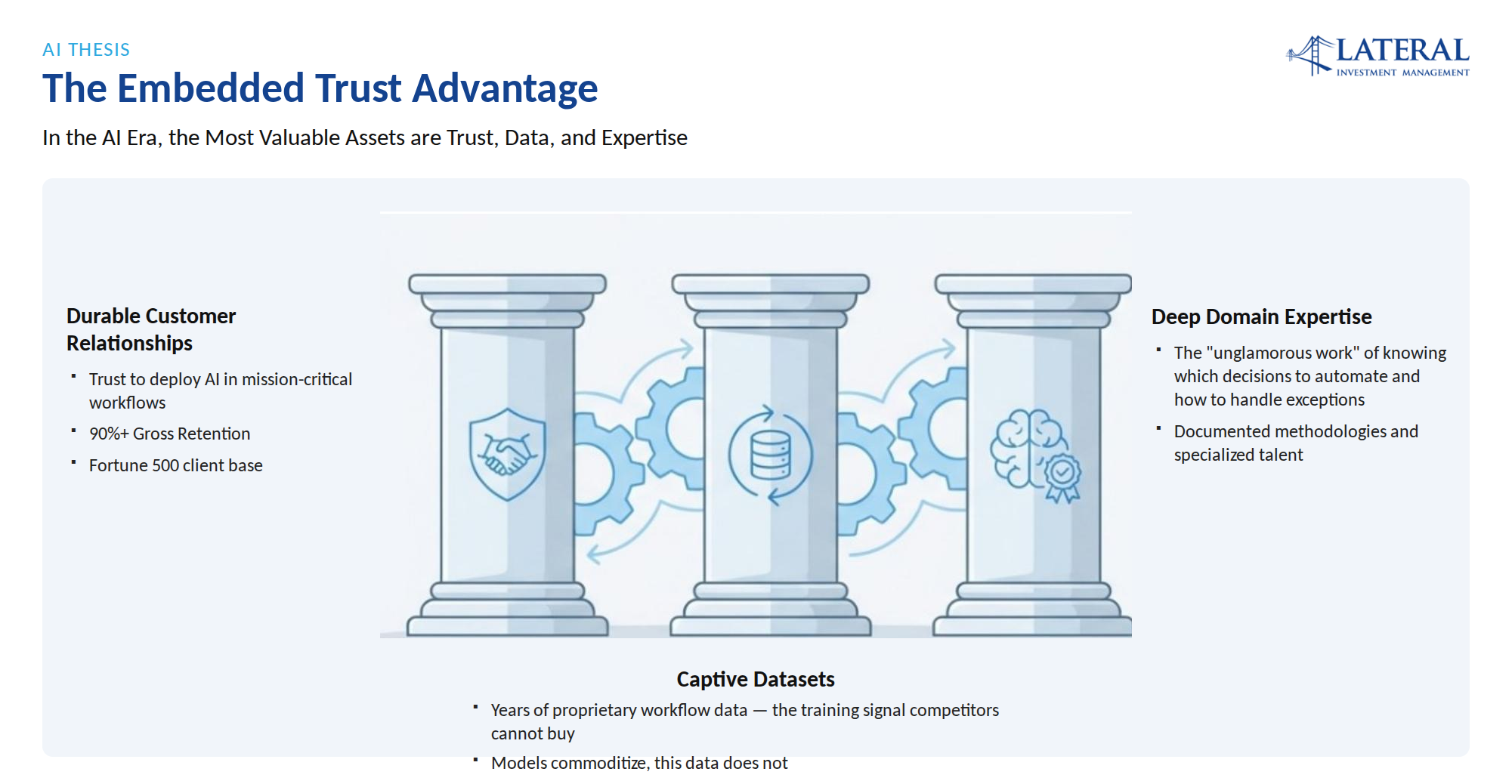
The Embedded Trust Advantage: three reinforcing pillars (Lateral).
What a model can't bring to the table
A general-purpose model is, by construction, good at general-purpose work and highly focused individual use cases. Drop it into a high-stakes complex industry flow with multiple stakeholders and highly specialized contextual requirements, and the model or the startup built on a general-purpose model misses the following three things:
- Lacks standing to be trusted with sensitive, regulated decisions.
- Doesn't have access to that industry's actual workflow data and even when it does, the data is messy, self-contradictory and increases the potential for risky and unpredictable AI outputs.
- Doesn't know which problems are worth solving, where the exceptions hide, or what "right" looks like when the rules are ambiguous.
Those three gaps map precisely onto three assets that established vertical software and services businesses already own. We call the combination the Embedded Trust Advantage, and in the AI era, the most valuable assets aren't models: they're trust, data, and expertise. Let's go through each of them.
Trust in customer relationships, i.e. the permission to deploy. The first pillar is the hardest to replicate and the easiest to undervalue. Years of consistent, mission-critical service delivery earn a vertical incumbent something an unknown vendor cannot buy or shortcut: the standing to put AI inside a regulated, high-stakes workflow. A bank does not hand its compliance examination to a startup it met last quarter; a health system does not let an untested tool touch clinical documentation. We look for embedded vendors hold 90%+ gross retention and Fortune 500 client bases precisely because that trust took years to earn and it gates who is even allowed to compete.
Data — the proprietary assets you can't buy. The second pillar is the training signal. AI performance in a narrow domain depends on data specific to that domain, and the most valuable such data is generated by doing the work — years of transactions, edge cases, and corrections that exist nowhere on the open web. A horizontal platform serving everyone has breadth but no depth in any one vertical; it structurally lacks the domain-specific corpus required to train a high-utility model for, say, insurance underwriting or pharmacovigilance. The incumbent that has been doing that work for fifteen years has exactly that corpus, and it compounds.
Domain expertise — subject matter context and judgment. The third pillar is the unglamorous one: knowing which decisions to automate and which to leave alone, how to handle the exception that the rulebook didn't anticipate, what a defensible answer looks like to a regulator. It lives in accredited talent, documented methodologies, and scar tissue. It's also what keeps an AI deployment from confidently producing the wrong answer at scale — the difference between a demo and a system a customer will actually run.
AI widens these strengths rather than eroding them
The usual story about AI is that it erodes historical competitive advantages: anyone can spin up a capable model, so incumbency is worth less. For these three pillars, we believe the opposite is true, because they reinforce one another. Relationships unlock access to data. Data sharpens expertise. Expertise deepens relationships. Each turn of that loop makes the next easier — and crucially, AI makes every pillar more valuable, not less. Better models raise the return on proprietary data; cheaper automation raises the premium on knowing exactly where to point it; and the more sensitive the workflow AI touches, the more the permission to deploy is worth. The moat widens as the technology improves.
The Embedded Trust Advantage highlights what horizontal incumbents are lacking and why they are structurally disadvantaged, not just temporarily behind. Breadth is the enemy of depth. A platform built to serve every industry cannot accumulate the regulatory trust, the vertical-specific data, or the domain judgment of any single one. Pair a generalist platform with a generalist model and you have a product that is substitutable on both layers at once — which is exactly the asymmetric repricing Part 1 documented.
Where this goes next
The Embedded Trust Advantage is the through-line of everything that follows. The next three posts take the pillars one at a time:
| Key pillars | Sustainable advantages |
|---|---|
| Permission to deploy | Deep and longstanding customer relationships are the gating asset, and the test for whether trust in adopting new technology translates into partnership. |
| Proprietary data | The unique data sets that are the product of human judgement and bespoke transactions, |
| Domain expertise | Subject matter knowledge that applies the first two pillars into a specific context, often with shifting regulations and industry-specific practices |