Every SaaS application ever built assumed a human user at a screen. The login, the dashboard, the seat license, the onboarding flow, the careful user-experience design — all of it exists to help a person navigate the software and get work done. That assumption was so fundamental it was never stated. Remove it, and the entire design premise of enterprise software comes apart. That is what "headless" means, and it is the architectural shift underneath the repricing of the whole category.
In a headless model, the user of the software is not a person — it's a 3rd party application or an agent. The interface is not a graphical screen but a protocol or an API. The software is invoked by other software, in service of a goal, and no human ever logs in to operate it. This sounds like a narrow technical distinction. It is actually the load-bearing change from which the death of per-seat pricing, the migration of the moat, and the disruption of entire software categories all follow.
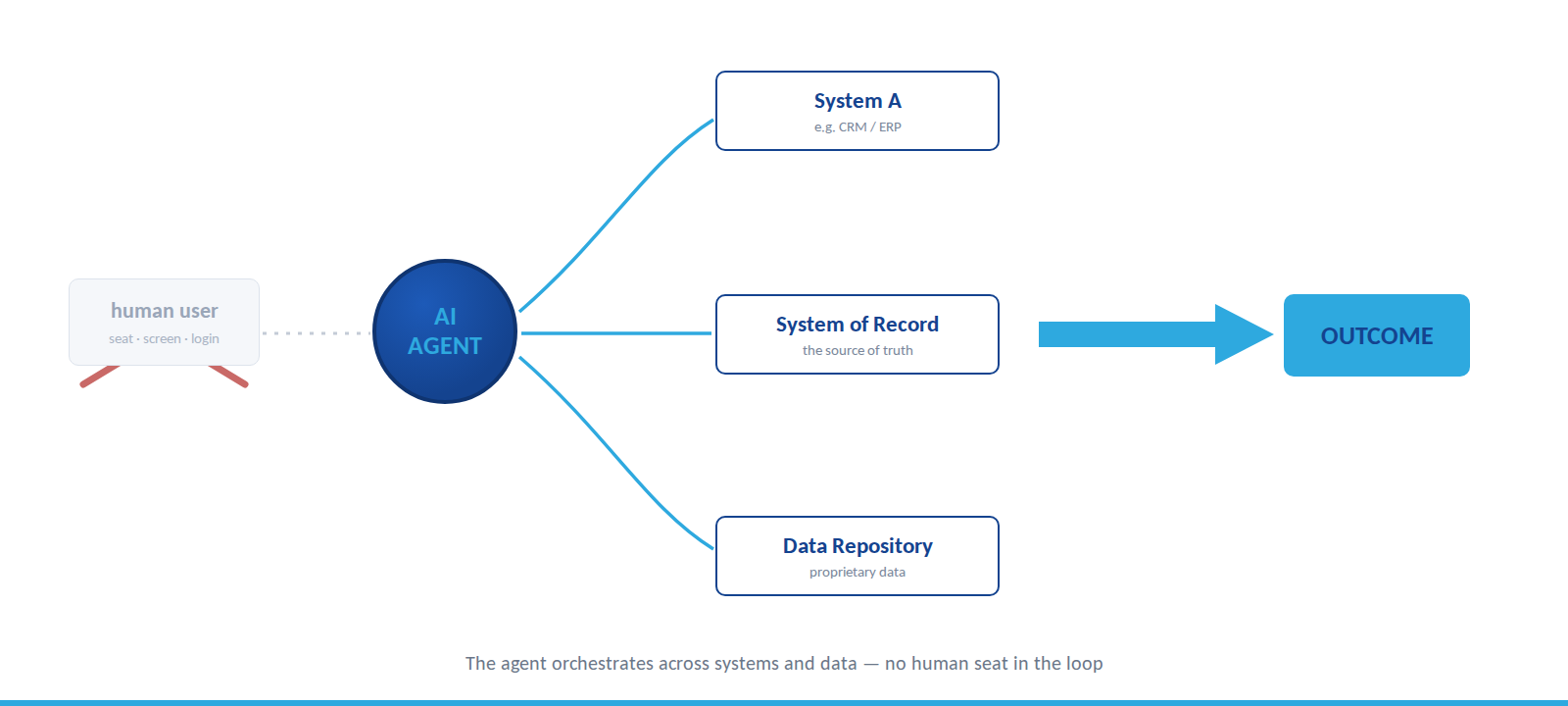
Headless: an agent orchestrates across systems and data, with reduced requirements for human seats.
What headless software actually looks like
Picture the way work moves through an enterprise today. A person opens one system to pull data, exports it, opens a second to reconcile it, emails a third team for an approval, then keys the result into a system of record. Each of those systems was built as a destination — a place a human goes to do a step. The workflow lives in the human's head and hands, stitched together by clicking.
In a headless model, an agent does the stitching. It reaches into the first system through an interface, pulls what it needs, reconciles against the second, requests the approval, and writes the result to the system of record — assembling the workflow dynamically rather than following a human clicking through screens. The systems become capabilities the agent calls, not destinations a person visits. The work still runs through the same underlying data and systems; what disappears is the human operator in the middle, and with them the screens, seats, and navigation that the software was mostly built to provide.
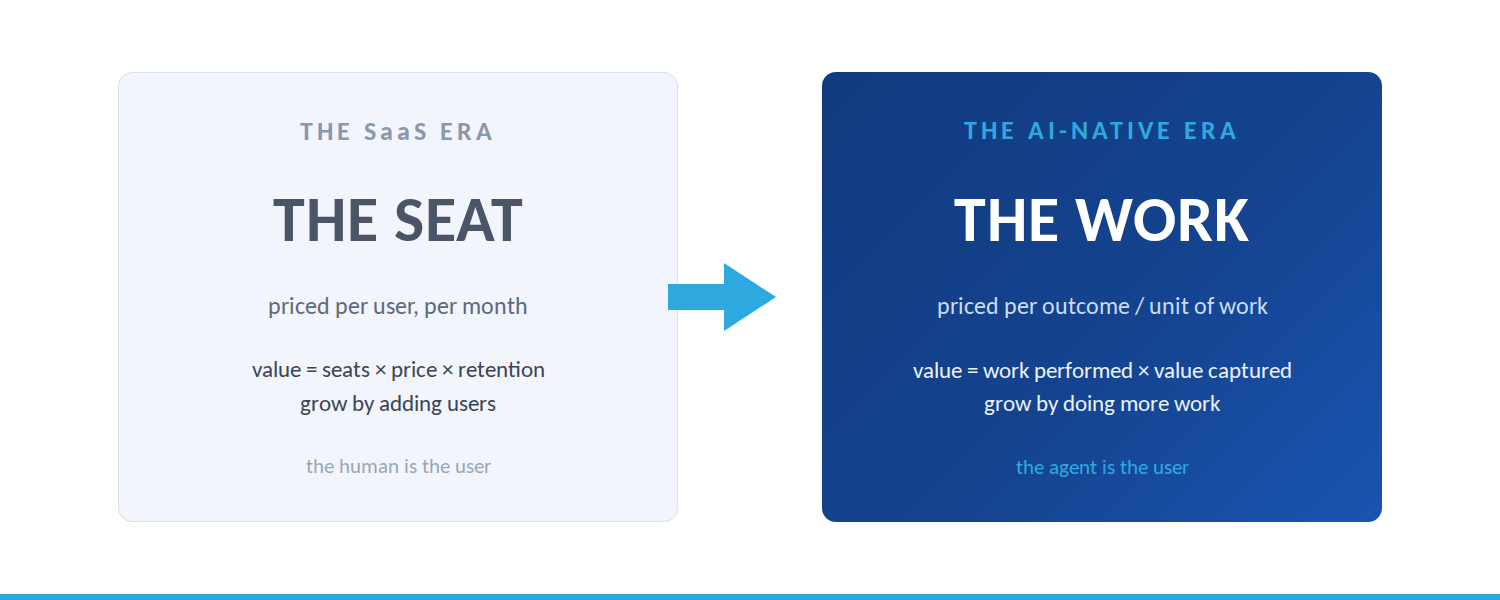
The first and most direct consequence is that per-seat pricing stops making sense. Seat licensing was a charge for human access; if fewer humans log in, there is a reduced need to charge for licensing fees. The 200 CRM seats a sales operation once needed becomes 150, then 50 for the parts an agent fully runs, even as the volume of work flowing through the system holds or grows. Revenue tied to seat count falls while the work rises, which is exactly the divergence that makes seat-based businesses suddenly hard to forecast. We take up the pricing model that replaces it separately; the shift here is architectural: headless removes the fundamental unit that the old model metered.
The second consequence is subtler and more important for anyone underwriting these businesses. A great deal of SaaS defensibility lived in mastery of the interface, complexity was lock-in: the workflows users had memorized, the dashboards teams had standardized on, the switching cost of re-training people on a new screen. Take the trained human who has invested in learning and mastering an interface and that lock-in evaporates — an agent does not care what the interface looks like. It does not need retraining to switch tools. What remains defensible when the interface is gone is what sits underneath it: the depth and exclusivity of the data the software can reach, the customization and accuracy of its domain logic, and its position as the system of record other systems must integrate with to get their work done. Headless relocates the competitive barrier from the surface to the substrate — from UX to data, domain correctness, and integration depth. That relocation is precisely why proprietary data and system-of-record position should be repriced upward while interface-level polish should be repriced down.
The third consequence is that entire categories are exposed. If a product's whole value was providing a human-friendly interface over a database, a place for people to enter, view, and route information, then an agent that can read and write that data directly makes the interface redundant. Form builders, project-management layers, off-the-shelf social schedulers, SMB-focused CRMs: products that were, in essence, a screen on top of a data store are losing value. The screen was the product and the screen is what "headless" models remove. The categories that survive are where the value was never primarily the interface — where it was the proprietary data, the regulated-domain logic, or the depth of integration that an agent still has to access.
Governance complexity grows and opens up opportunities
There is a final consequence that cuts the other way, and it favors incumbents. A headless agent reaching across systems and into data repositories to act autonomously raises the stakes on access control, auditability, and data governance enormously. Who is allowed to let an agent into the claims files, the general ledger, the patient records? What is logged, what is reversible, who is accountable when an autonomous action is wrong? These are not questions a customer answers for a vendor it met last quarter. The permission to run agents inside sensitive systems is granted only to parties already trusted to be there — which means the headless shift, for all its disruption, hands a real advantage to the incumbents who already hold that trust and already run the governance the model requires.
The prize here is real, and it is growing quickly. Gartner expects at least 15% of day-to-day work decisions to be made autonomously by agentic systems in 2028, up from effectively zero in 2024, and 33% of enterprise software applications to embed agents by then, up from less than 1%. By early 2026, 62% of organizations were already experimenting with agents and 23% were scaling them in production. See Gartner release. The relevant question for an investor is therefore not whether agents get deployed inside core systems. The question is who gets to deploy them, and the answer turns on who the customer already trusts to be there.
That trust is not a soft factor. It is the operational precondition for autonomy, and it happens to be the thing incumbents have spent years building. IBM's 2026 study of technology executives found that organizations embedding control directly into their AI systems experience 25% fewer incidents than those relying on oversight bolted on after the fact. Mature access control, auditability, and rollback are not a tax on agentic AI; they are what lets it run at all. The firm that already operates the customer's governance is not starting from a demo. It is starting from the position every agent deployment has to reach before it ships.
Vertical SaaS vendor Guidewire which which is the leader in the insurance vertical focused on property and casualty core systems, illustrates the point. Guidewire holds a significant share of Tier 1 and Tier 2 carriers globally (570 insurers in 43 countries) and carries the compliance certifications insurance CIOs require. Guidewire's applications already sit inside the claims file any agent would need to touch. Its agentic capability therefore arrives as an upgrade to the platform carriers already run rather than a handoff to an AI-only vendor onboarded last quarter, and its ARR grew 22% in the second fiscal quarter of 2026 as carriers chose to modernize rather than replace. (Cited below)
The change for enterprise buyers needs to be an evolutionary one rather than a revolutionary one which favors vertically focused incumbents in both software and services. Agentic AI does not require tearing out the systems of record and the relationships wrapped around them. It rewards adding human-overseen autonomy to validated and trusted systems. An AI-only challenger has to win the trust, rebuild the governance, and absorb the migration risk (and add the human assist services capabilities to their technology capabilities) before it can deliver routine and reliable value. It may win pilot programs but asking the customer to route the claims file or the general ledger through a relationship measured in months is a risky proposition. The incumbent services firm delivers the same capability as an upgrade to infrastructure the customer already runs, under controls the customer has already approved. For the customer that is the lower-risk path, and for the investor it means the economic value of agentic AI is more likely to accrue to the customer and its trusted partners than to the startup tech vendor.