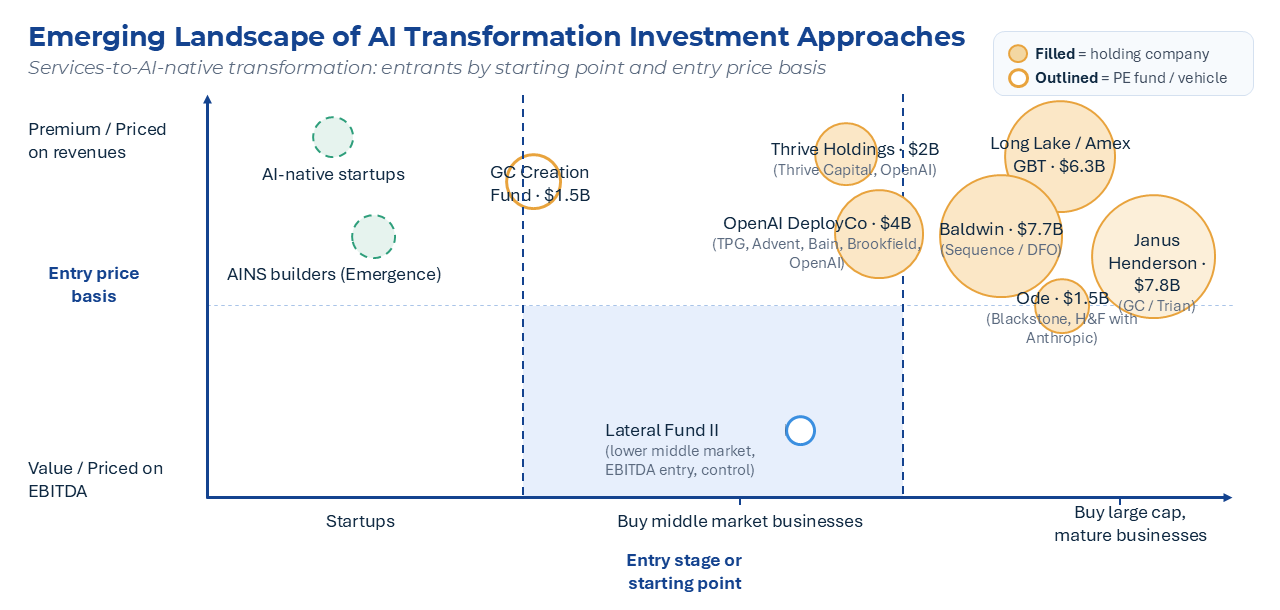
This Lateral insights section opened in January with a post about what the enterprise focused AI-native software company actually is: a different kind of asset, whose value is the work performed rather than the access provided, because the atomic unit of software has shifted from the seat to the work. From there we traced the consequences. The old boundary between scalable software businesses and linear-growth services businesses is blurring, because AI-native software performs the work itself and carries software economics into labor-scale problems. As agents begin to replace humans as the primary user of tech, per-seat pricing is less relevant. And when adoption runs ahead of measurement, token burn, pilots, and partnership announcements can become inadequate proxies for progress, subsidized by short-term capital markets euphoria but inevitably destined to meet an ROI test. This post draws those threads into a set of 5 rules, and names the three qualities we look for in companies that can success in transformations from services to AI-native transformations.
The 5 rules
Five patterns emerge from the transformation cases. Together they begin to describe how value is being created, measured, and defended in an AI-native market.
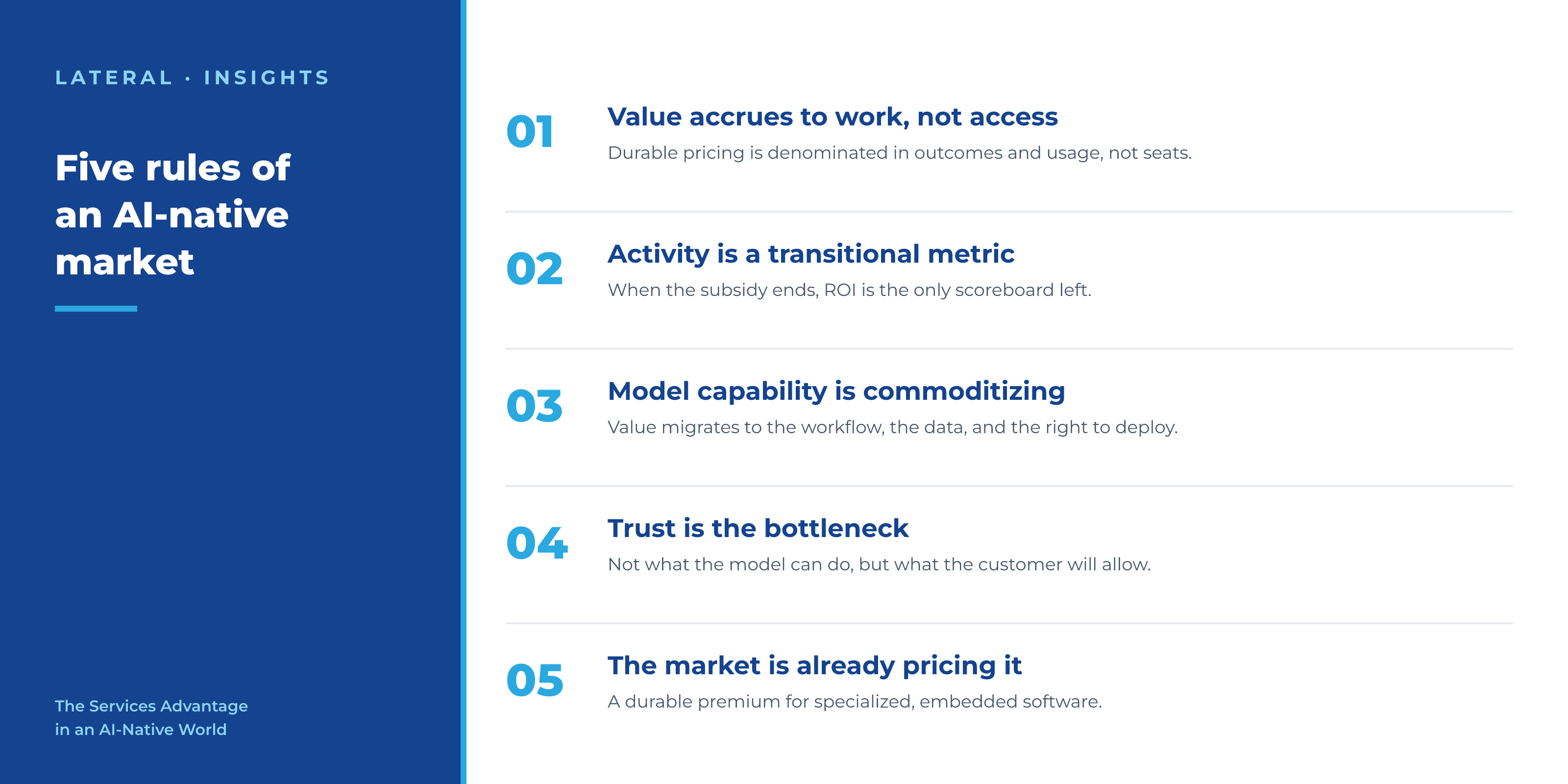
The first rule is that value accrues to higher productivity solutions which deliver work performed, rather than workflow. The system which intelligently underwrites a loan (even with a need for ultimate human review) is more valuable than a system which aggregates an online workflow for an underwriter to evaluate. The SaaS seat was only a proxy for a human who would do the work; when the software does the work itself, the output, not the login, is the result. Durable pricing models in this cycle should be denominated in outcomes or in units of work. Pricing that counts users leaves the largest part of the value, the displaced labor or the increased productivity of labor, uncaptured.
The second rule is that AI token activity is a transitional metric. In the adoption phase, AI usage looks like progress. Bullish capital markets are willing to underwrite some of these costs, for now. That subsidy is temporary. When it ends, ROI is the only scoreboard. The leaderboards and AI partnership/pilot announcements that resound through the current moment are not sustainable in companies with rational financial practices.
The third rule is that raw model capability is commoditizing at the application layer. For a growing share of business workloads the newest frontier model is no longer worth the token cost over the last one (no different than an iPhone upgrade cycle which has become more fashion than function). The gap between vendors narrows with every release and the open source alternatives are catching up more quickly with each cycle. Sustainable differentiation is moving away from the model and toward everything that surrounds it: the workflow it runs inside, the proprietary data that tunes it, and the right to deploy inside the firewall where the work happens. The model is likely to become the modular, swappable part of the system, and the defensible value is accumulating in how it is used.
The fourth is that trust and reliability, not tech capability, is the binding constraint for enterprise AI. In consequential, high-visibility workflows the question is rarely how limited the models are in terms of capabilities. Models still make foolish assumptions, childish mistakes, hallucinate or cause unexpected outcomes. The limit is not the models, but what the customer will permit or should permit the model to do without a human in the loop. In medicine, law, finance, and safety-critical operations, the cost of an AI error is high. An established vertically focused services vendor with years of history and experience with a customer's business process is better positioned and aligned to design a process for supervised AI operations than a more technically capable but unproven startup competitor that is incentivized to take more risk at its customers' expense to get to its next round of funding.
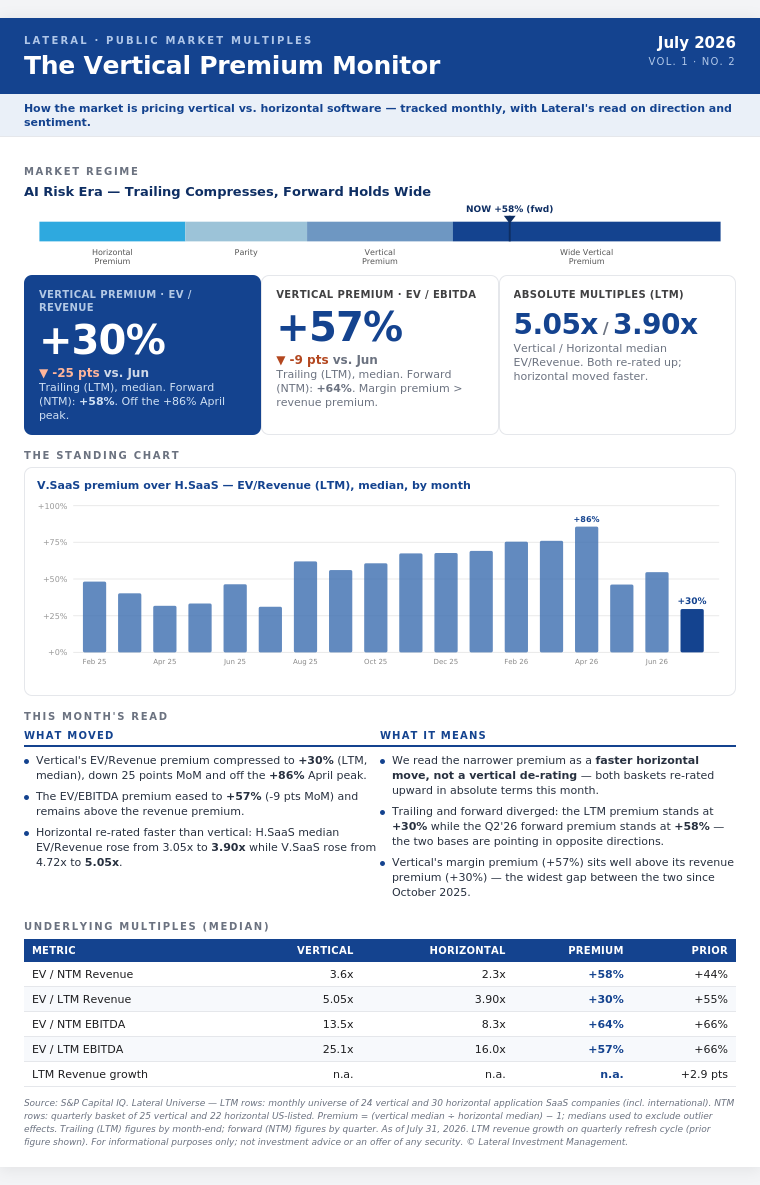
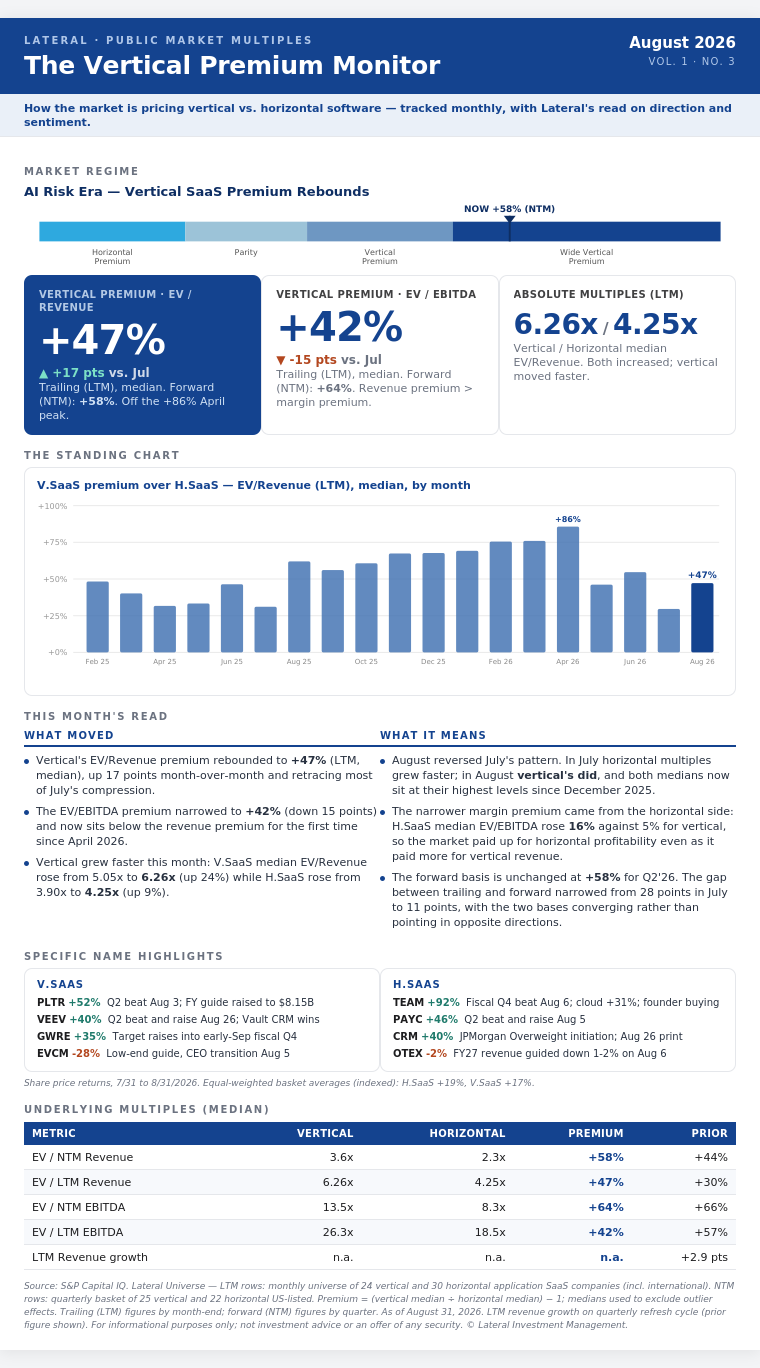
The fifth rule is that vertical specialists are advantaged over horizontal generalists and the stock market is already pricing the difference in the valuation premia for Vertical SaaS and Horizontal SaaS (Lateral analysis, S&P Capital IQ analysis, 2018-2026; see forthcoming posts). This vertical premium is a reversal from the horizontal premium which existed during the post-pandemic SaaS boom because vertical SaaS could claim a smaller TAM while horizontal SaaS generalists claimed much larger markets for growth. Now that specialization which was a penalty because of a narrower focus is perceived as an advantage. Vertical SaaS is favored for adhering to the four rules above and we believe those advantages will widen as AI-native business models take hold. Even ahead of the analysis that follows, public and private multiples reward specialized, embedded software over undifferentiated horizontal tools. By one M&A advisory's measure, vertical software carries a premium on the order of 25 to 30 percent at comparable performance, and the gap has widened rather than closed as AI has spread [Windsor Drake, as of February 2026]. The market is not paying for access to a model, which anyone can rent. It is paying for the assets around the model that a model cannot reproduce, which is where the rest of this analysis concentrates.
Enter the Three D's
If those are the rules, three differentiating qualities decide which services or software vendor wins in the enterprise AI market. We call them the Three D's. Each is something an AI model can amplify but cannot manufacture, and each grows more valuable, not less, as the model itself commoditizes.
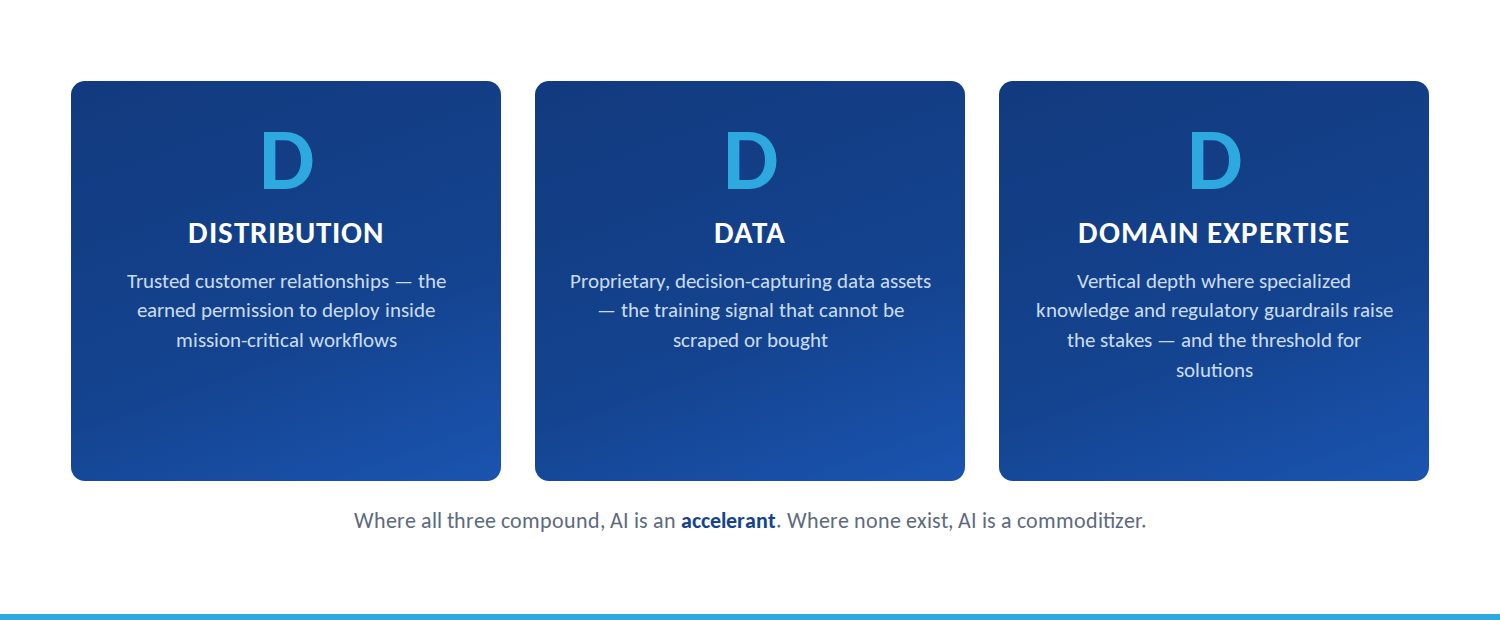
The Three D's: distribution, data, and domain expertise — the assets AI cannot commoditize.
Distribution — trusted customer relationships. Distribution in an AI-native market is not just marketing reach or a large user list with past transactions. It is the earned right and depth of relationship to operate inside mission-critical workflows. The emerging AI-native capabilities in specific verticals produce revenue only if deployed through a trusted relationship with a customer willing to let software touch work that matters. That willingness is built over years of reliability, references, and accumulated goodwill. It cannot be bought in a quarter or manufactured with a better demo. An incumbent with a good-enough model for technology and deep customer trust routinely can beat a cutting-edge frontier model at arms length, playing in an endless pilot or sandbox. The trust is embedded in the existing services channel. Distribution is the first quality we look for, because a business without customers is selling in search of product/market fit rather than bringing AI-native solutions to an existing business process that needs a rethink.
Data — proprietary data assets. Valuable data assets are proprietary, decision-capturing, time-dense records of how judgment is exercised in a specific domain: not just what happened, but what an expert decided, why, and what followed. This training signal cannot be scraped from the public web and cannot be purchased , because it is the exhaust of real operations that only an embedded services operator generates. A foundation model crawls the Internet, sneaks behind paywalls but it cannot capture how a particular underwriter price a particular risk, how a particular clinic sequences a particular treatment, or how a particular firm has resolved a thousand edge cases in its field. That record is what turns a generalist model output into a specialist solution. The value of the data compounds compounds so that every decision the system supports adds to the corpus that makes the next decision better, widening a gap that competitors cannot close.
Domain expertise — Domain expertise is command of a sub-sector where specialized knowledge, subject-matter judgment, and regulatory guardrails raise both the stakes for the customer and the threshold for any solution. Where the cost of being wrong is high, expertise is the key frame of the product, not a layer added on top of the model. Someone has to define what correct looks like, encode the rules the domain enforces, anticipate the failure modes a generalist would miss, and stand behind the result when a regulator or a court asks. In regulated and high-consequence fields, the vendor that owns the domain knowledge and depth of subject matter expertise does not merely build a better product; it builds the only product an enterprise buyer can responsibly adopt.
Where all three D's are present as capabilities in a vertical services or software opportunity, AI is an accelerant. Where they are lacking, AI is a brutal commoditizer, turning low-margins value added resellers into disintermediated middle men. We believe that many of the fundamental investment questions in the business of transformation of services to AI-native companies reduce to assessing which degrees of these three capabilities a business possesses.