AI transformations are the latest category in the private markets, gaining popularity and adoption from large VC and PE investors. The AI transformation moniker spans rollups, corporate transformations and services to AI native transformations (SAINT), even though they are three different strategies that rhyme in approach but have different attributes, risk factors and are focused on different levels of scale. In short, the various AI transformation players occupy different parts of the overall market opportunity.
First, a comment about "Transformation" with a big "T" which is a word that gets bandied about and co-opted by marketing campaigns. Before "AI Transformation", there was "Digital Transformation" which meant different things in different phases from hype to reality. First, it meant having a "dot com" website, then it meant moving your business to the Internet or the cloud. Similarly, AI transformation has started with setting up a chatbot, adding a .ai domain as signals of technology leadership and innovation. We are very much in the hype phase where the promise is greater than the reality. We are just at the beginning of AI adoption to improve and optimize business processes. In our opinion, AI will eventually transform the white-collar economy but we believe the best starting point is with lower middle-market services companies with sufficient scale where AI transformation can make a fundamental difference to unit economics and staffing requirements but that are nimble enough where adoption can be done quickly and with minimal disruption to customers.
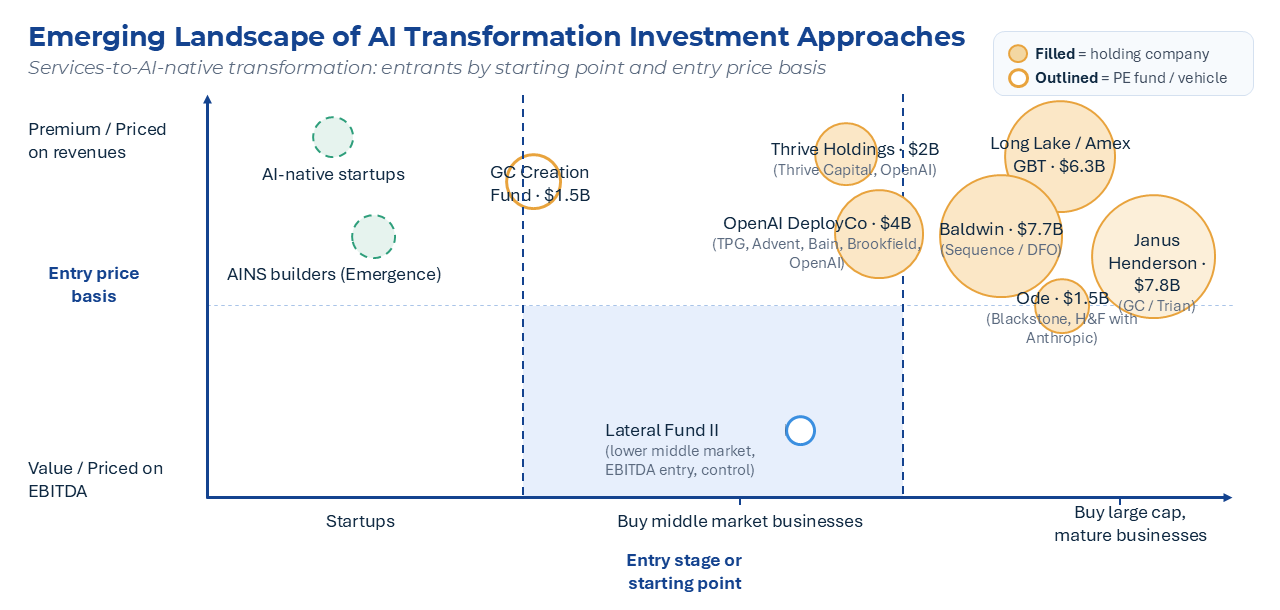
Emerging landscape of AI transformation investment approaches: positions reflect Lateral's qualitative assessment; bubble areas scale to disclosed committed capital or transaction equity value; dashed bubbles illustrative (company disclosures; Lateral). As of September 2026.
So-called AI Transformations range on a spectrum from AI adoption to AI-native transformations. Adoption can be incremental and applies to all businesses. Just as every business has a website, now every business will adopt AI as chatbots, "vibe" coding and agentic solutions become ubiquitous. But AI native transformation is a more fundamental reimagining where AI can automate a labor-intensive business process. In our view, many businesses are not relevant to AI native transformation (at least, in the way that we perceive it), especially B2C industries like retail stores and restaurants. AI native transformation is most applicable to B2B white collar services and goes beyond automation and machine learning (not a new concept) to autonomous execution of routine and repetitive work by intelligent agents, subject to human review and direction. The most obvious fits are knowledge worker segments such as consulting, legal, accounting, insurance banking and industries with large back-office bureaucracies such as healthcare, government and construction. The least likely fits are blue collar segments such as HVAC, trucking and where physical work is conducted that are safe, at least for the moment, until AI progresses into the physical world.
All of the AI transformation strategies seek to put the AI story in the forefront of their investment thesis and some will be more story and others more substance. The entrants differ from us in their desire for scale most significantly as well as market segment, entry economics, starting point, and ownership model, and this post maps those boundaries because the labels have begun to blur together.
Even though our AI transformation thesis was published in December 2025 and our strategy has been active since 2018, Sequoia seems to get credit for publicizing the trend/opportunity. Sequoia partner Julien Bek's March 2026 essay argued the next trillion-dollar company will be a software company masquerading as a services firm, anchored on the ratio of six dollars of services spend for every dollar of software, and sized the verticals: management consulting at $300 to $400 billion, recruitment and staffing above $200 billion, IT managed services past $100 billion [CITE: Sequoia Capital, "Services: The New Software," March 5, 2026, https://sequoiacap.com/article/services-the-new-software/]. Emergence Capital's Jake Saper has been developing an early-stage AI-Native Services (AINS) thesis since April 2024, with investments in Mechanical Orchard, Pace, and Hanover Park, and he convened an AINS founder summit in New York last month [CITE: Newcomer, "Is AINS the Next SaaS?," August 19, 2026, https://www.newcomer.co]. The frontier model leaders are converging on the same conclusion from above: Fortune reports that OpenAI and Anthropic are both building partnerships with PE firms to drive AI-driven efficiency [CITE: Fortune, "Are services the new software?," April 21, 2026, https://fortune.com/2026/04/21/services-are-the-new-software-sequoia-venture-capital-julien-bek-ai-native-eye-on-ai/].
At Lateral, we focus on founder-owned lower middle market businesses because they are nimble, lean and have loyal customer bases which we believe are the ingredients that are suited to transformation. Trying to apply the same concepts at scale is a very different proposition and is reminiscent of the difficulties of digital transformations at scale (AOL/Time Warner or Dex Media, the attempted digital transformation of yellow/white pages businesses), especially if the valuations are high and the value of the transformation is paid out in the entry cost. We have two recent examples of exuberant take-privates with stated transformation theses that have paid forward their AI thesis. Michael Dell's family office announced a partnership with AI holding company Sequence to buy Baldwin for $7.7 billion at an 88% premium to the public stock price [WSJ] and Long Lake's agreement in May to take American Express Global Business Travel private for $6.3 billion at $9.50 per share, a 60.2 percent premium to the prior close [CITE: Amex GBT / Business Wire, "Long Lake Agrees to Acquire Amex GBT," May 4, 2026, https://www.businesswire.com/news/home/20260504231235/en/]. Conflating "service as software" is especially risky if you pay software prices for services growth and margin profiles. [CITE: CNBC, "Silicon Valley's new buyout playbook is hitting Wall Street," June 8, 2026, https://www.cnbc.com/2026/06/08/silicon-valleys-new-buyout-playbook-is-hitting-wall-street.html].
These deals speak to an emerging trend among megabuyout firms who want to get in on the AI wave, more to spur adoption at their companies than to build AI-native businesses. Two consortiums have partnered with frontier models which gives them access to customized technology and early roadmap, but tying to a single technology provider in a rapidly-changing landscape has trade-offs and limitations. For the frontier company, it locks in buyers of tokens which they need to show momentum and raise more capital; for the consortium partners, it buys expertise, limited access to technology and a share of the spotlight. Blackstone and Hellman and Friedman are partnered with Anthropic on Ode. TPG, Advent, Bain Capital and Brookfield are partnered with OpenAI on the OpenAI Deployment Company.[WSJ] Think back to how this model didn't work in different ways with @Home in the cable industry around broadband and with Hulu in streaming. Each launched with great fanfare in an early market phase and struggled to prove effective as market conditions and partner priorities diverged.
Finally there are holding companies like Thrive Holdings, Sequence and Long Lake which are centralizing the AI transformation and building out a portfolio in vertical categories. Again, the challenge is to effectuate transformation at scale. The thesis is that the sum of the parts should be greater than the whole - an idea as old as the industrial conglomerate from ITT in the 1970s to GE in the 1980s to Industry Ventures in the 1990s.
The destination these strategies describe is the one we have underwritten from the start: take a people-intensive services business with low growth and low margins, and transform it into a higher-growth business with recurring revenue, expanding margins, and a technology core. We welcome a market that now believes this is possible. Our transformation inspiration and end goals are the same, at least for those who are looking to build AI-native businesses, not just promote AI adoption. While we focus on a concentrated portfolio of lower middle market buyouts focused on niche markets at disciplined valuations, the new players from VCs to mega-buyout firms discussed in this post naturally look for transformation at scale, which is inherently more expensive to get into and more difficult to execute and accomplish. As lower middle market investors, we will stick to the sub-scale transformations that are substantial enough to make huge economic differences and simple enough to accomplish with limited capital requirements and shorter durations. For years the consensus held that services businesses were only good for financial engineering. We welcome a market that now recognizes the upside potential of services companies for AI transformations.