Software markets have historically developed as a growing component of overall information technology (IT) spending, which accounts for approximately 5% of Fortune 500 companies' operating expenses, according to Deloitte. While software has historically produced overall productivity gains (debatable for some periods), it has created a high-paid class of jobs that are skilled workers trained to operate and use the software. The "white collar" skilled labor market is 5-8x times larger than software budgets alone, according to McKinsey estimates, and accounts for 25–40% of operating expenses in knowledge-intensive industries. We believe that AI-native vertical AI platforms have a new and different opportunity to compete for this "white collar" labor budget in ways that were not possible for legacy horizontal software players.
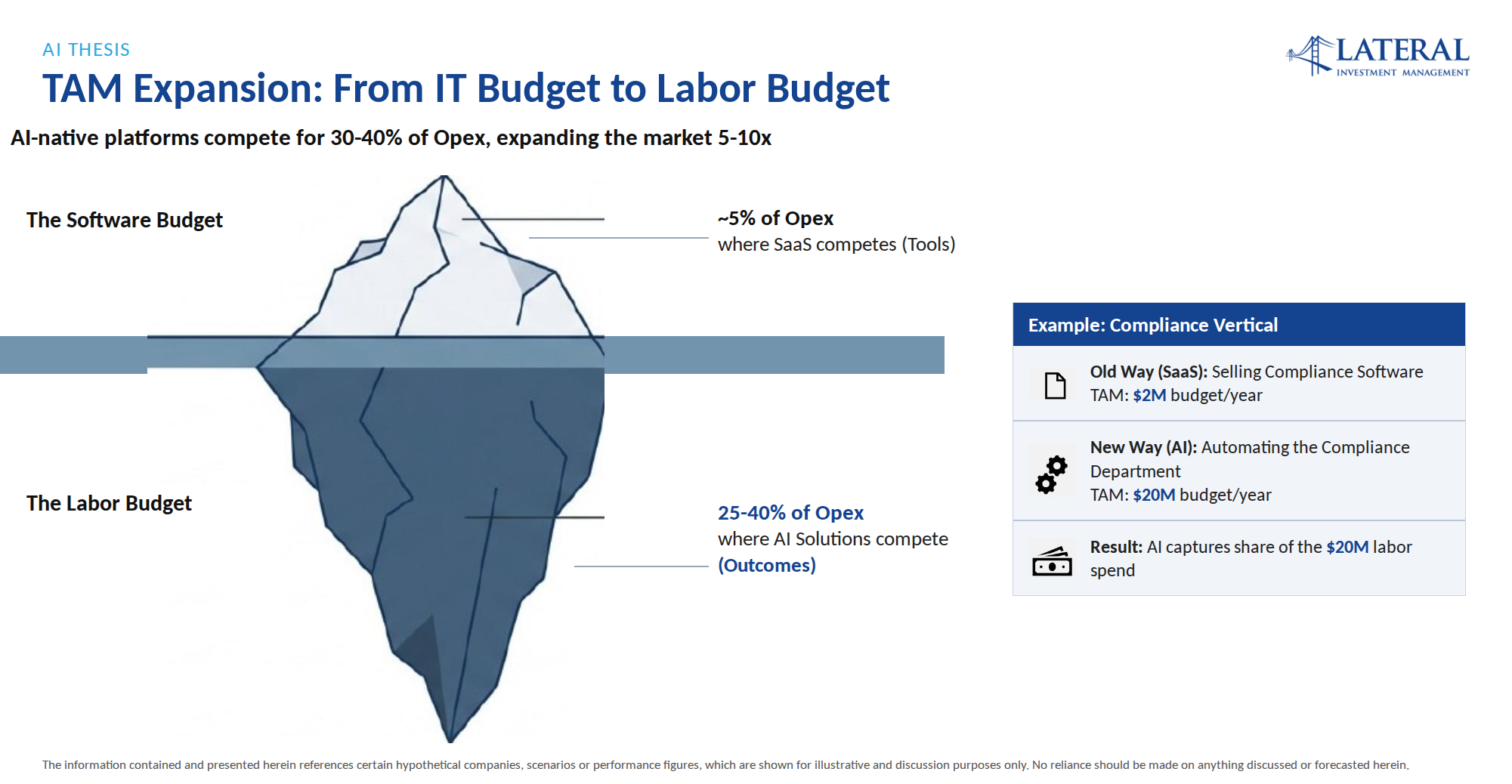
TAM expansion: from the software budget (~5% of opex) to the labor budget (25–40%) (Lateral).
Below the waterline of the software budget is the much larger labor budget
Traditional software competes for the tip of the proverbial iceberg. A vertical AI platform that performs the work rather than merely coordinating it can address the underlying labor budget. This contrasting opportunity between enterprise software and vertical AI solutions merits a concrete example. The compliance department in a regulated enterprise like a bank, a utility or a pharmaceutical company has mushroomed in size and complexity over the past 20 years. There's a dedicated segment of enterprise software called governance, risk and compliance software (GRC) that has competed for tens of millions of dollars in IT budgets of regulated companies which use these platforms to update their regulatory filings, review internal practices and to stay current on regulatory obligations. Compliance departments staff hundreds of lawyers, accountants and dedicated professionals who keep their companies out of trouble and avoid hundreds of millions of dollars or even billions of dollars in fines and/or worse, accidents or environmental damages.
An AI-native compliance platform that actually drafts the policy updates, prepares the audit workpapers, and generates examination-ready documentation isn't competing for the software budget anymore (e.g., $2-5M). It's competing for a share of the much larger labor budget ($20-50M) of the in-house function it augments and replaces. The addressable opportunity moves from the software line item to the labor economics of an entire division inside of a large corporation. That's where the market multiplying expansion comes from when we consider the labor replacement market.
The third-party estimates when considered across the global economy get large quickly and dwarf the historical markets seen through a software lens. McKinsey puts the annual productivity value of generative AI across knowledge work at $6.1–7.9 trillion (cite). Others blur the future of software with AI agents to expand the software market. Goldman Sachs estimates AI agents will expand the enterprise-software TAM by at least 20% and certain verticals, like customer service, by 20–45% by 2030, further projecting that agents will account for more than 60% of the total software market by then (cite). Gartner forecasts that by 2035, agentic AI could generate nearly 30% of enterprise application software revenue, surpassing $450 billion (cite).
The labor-market opportunity has never been part of the software budget. When the denominator of the market size shifts from the technology line to the labor line, the same vertical that looked like a niche, possibly sub-scale market for enterprise software becomes a claim on a meaningful slice of an industry's cost structure.
##Where white-collar budgets are vulnerable to AI risk
Drilling down on the compliance department illustrates how the significant this opportunity might be. Global banking company Citi disclosed that about 15% of its global workforce of roughly 30,000 employees are classified in risk, regulatory, and compliance roles, up from 4.3% a decade earlier (cite). That's a 3.5x increase in compliance intensity at a single institution. And despite that investment, Citi was fined $400 million in 2020 for compliance deficiencies. The costs may be high but the downside risks are even bigger (cite). The enterprise compliance budget in regulated industries such as financial services, healthcare and increasingly technology, is exactly spend an AI-native platform can credibly go after, because the legacy approach to compliance is expensive and ineffective.
Multiply that pattern across regulated industries such as financial services, energy, pharmaceuticals, and increasingly, technology, and you arrive at the opportunity Lateral has scoped across 10 vertical niches, which we will go into in more detail in a subsequent post. Not because the software budgets alone in those verticals are large, but because the labor budgets are.
Why the AI solutions budget is defensible and better suited to vertical AI
The AI solutions that can be generalized such as document preparation and RFP responses will commoditize quickly. But replacing high-stakes work and decisionmaking in regulated industries is difficult to generalize. This work is mission-critical. Errors carry regulatory penalties, legal liability, or direct financial loss, so customers won't hand the work to an unproven vendor and will pay a premium for reliability from one they trust. The work is workflow-intensive across multiple actors and agencies, with multiple handoffs across stakeholders and systems that a generic tool can't bridge. Vertical services companies understand that context and earn the right to customize their processes and act as stewards of their clients' data.
And vertical AI opportunities may come with new ways of making money, such as the chance to embed financial services such as payment infrastructure. Think of a construction platform managing sub-contractor payments that can embed lending, manage cash floats; a legal platform coordinating closings can embed title and escrow; a govtech company can charge end-users for premium services on behalf of municipalities. The opportunity to turn software into financial infrastructure adds switching costs application software alone cannot match.
Vertical markets don't tend toward the winner-take-all dynamics of horizontal software: network effects and standardization reward generalists, while depth and specialization reward verticals. We would argue that vertical markets are appropriate risk/reward for middle-market private equity investments, not for high-risk, high reward VC strategies. The result of a successful vertical AI transformation is a high-margin, locked-in franchise that is defensible, but it is captured relationship by relationship rather than a land grab.
The hurdle for the vertical AI company to address labor budgets is to move well beyond coordinating work to performing it, and performing it correctly enough that a customer will replace headcount. That requires exactly the assets the last 4 posts have been about: the trust to be allowed inside the workflow, the proprietary data to train a model that performs domain-specific work, and the expertise to know which parts can be automated safely. A horizontal platform coordinates; it competes for the 5% software tip and stays there. A vertical platform with the three pillars can credibly perform the work and reach the 25–40% below the waterline.
We believe the white-collar labor budget in large enterprise businesses is structurally available to the capable vertical AI specialists and out of reach for the horizontal software and services generalists that are confined to IT budgets.