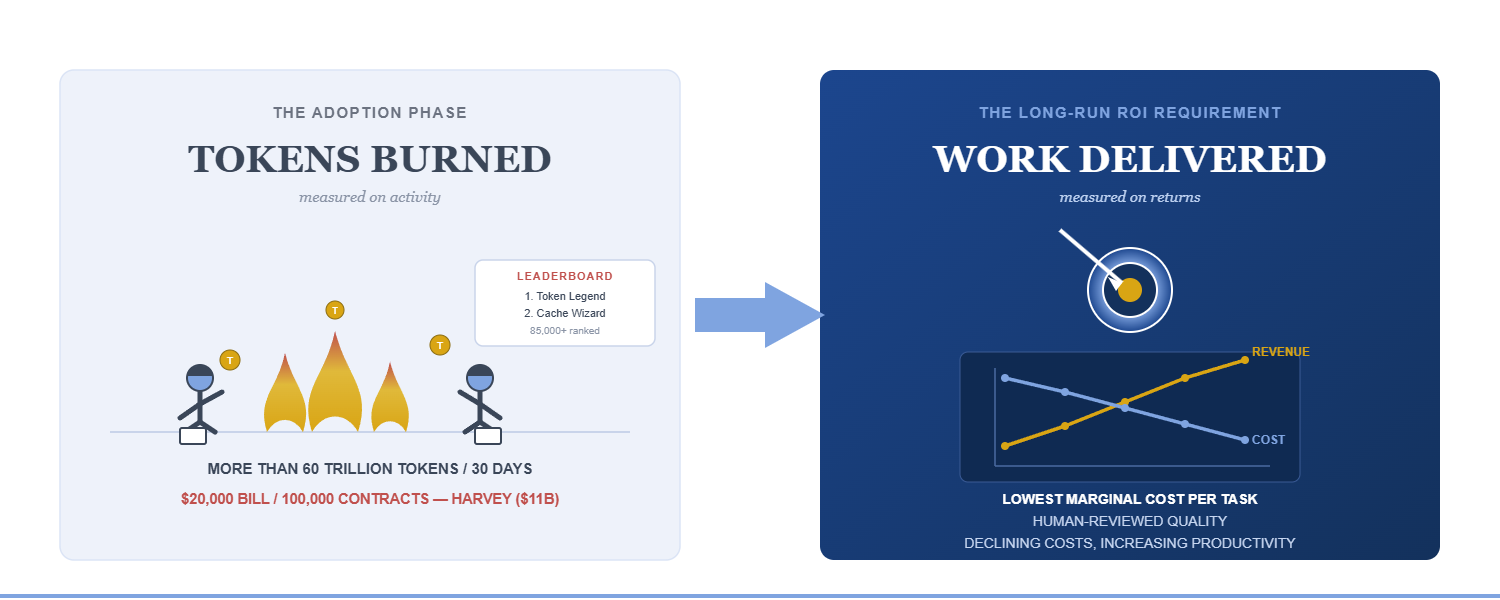
When the user is an agent and the software does the work, "per user per month" seat-based contracts become less and less appropriate because the primary success measure is no longer user activity and there are fewer users to count. The question a legacy SaaS vendor has to answer becomes more fundamental than a pricing tweak: if seats are no longer the most relevant and active unit, what exactly are you selling? The answer, for AI-native software, is increasingly the work output itself — and the pricing model has to be reimagined from the ground up around the value delivered rather than the number of people with logins.
This change is not a minor commercial adjustment. The change in pricing reflects the overall shift from coordinating work to performing it, from human users to agents, from the software budget to the labor budget. The overall target budget is much greater and the alignment potential with customer requires much better. If an AI-native company can build genuinely work-performing, headless software but still monetizes it like a seat-based tool, it has done the hard part and forfeited the reward.
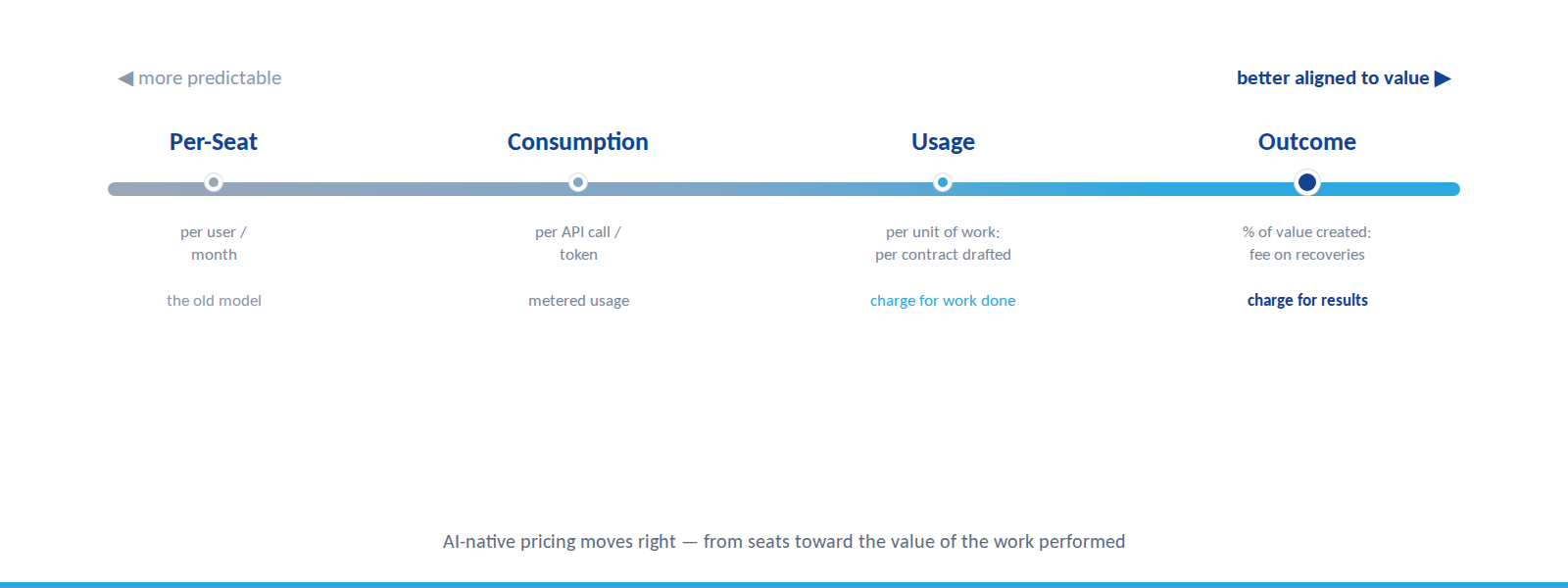
The pricing spectrum: from per-seat toward usage and outcome-based pricing (Lateral).
From the seat to the work as a unit of value
Seat-based pricing worked because it was simple. It tied revenue to a countable, growing quantity: the humans using the product. The structural challenge in an agentic world is that seat count should decline as the product improves. The more work the software performs autonomously, the fewer people log in, so the vendor is penalized for delivering more value, and no durable business model can rest on an incentive that is inverted. The trend is already in flight: A report by Metronome/Stripe reported that 77% of the largest software companies have incorporated consumption-based pricing into their revenue models, and 85% of the SaaS companies surveyed already had usage-based pricing in place, as of January 2025. [Report].
If per-seat is no longer the one-size-fits-all pricing for all use cases, there are two candidates have emerged at different points on the spectrum. Usage-based pricing charges for the work performed, per contract drafted, per claim adjudicated, per invoice processed; Intercom's Fin agent is a good example (as of this writing), billing roughly $0.99 for each conversation it resolves rather than for the people who handled it [Fin]. Outcome-based pricing goes further and charges for the result, a share of the savings identified or the value recovered. Sierra, former Salesforce COO Bret Taylor's agent company valued at $15.8 billion which claims more than 40% of the Fortune 50 as clients [CNBC]. Sierra says it charges per resolved outcome and nothing when a conversation escalates to a human. The report indicated that a support interaction costs $10 to $20, most of it replacing labor, and Sierra collects a fraction of the cost it eliminates.
Each step along that spectrum, from platform fee to consumption to per-unit-of-work to pure outcome, buys alignment at the cost of predictability and raises the measurement burden. A fixed subscription is predictable but misaligned. A pure outcome fee is fully aligned but far less predictable until fully deployed. Usage pricing sits between them and raises a thorny question every AI-native vendor is confronting: who should absorb the cost of the model. If a customer's agents drive heavy inference, whether by necessity or by some level of inefficiency, the variable cost can range from trivial to prohibitively expensive. During this early phase of adoption, the market doesn't yet discriminate efficiently to penalize solutions that are inefficient - we believe the savings of agentic solutions over labor should be 50% or greater. In some cases, the cost of inference vastly exceeds the cost of the labor and some of the out-of-the-box frontier-solutions fall into this value trap.
Why outcome pricing favors the specialists
Outcome-based pricing unlocks the labor budget when the savings are obvious, because it lets a vendor charge a fraction of the value of the work replaced rather than a nominal fee for a tool, which is how a single customer relationship becomes worth a multiple of the old per-seat contract. The pricing can be set against a labor cost basis, not a license budget. But the model is available only to vendors that can measure the outcome and attribute it credibly, demonstrating that the saving was real and quantifying the labor displaced. Bain's May 2026 analysis of the agentic software market tries to narrow the short-term targets for this transformation, identifying knowledge worker use cases such as "cross-workflow decision context" and "proprietary, outcome-linked data" as the immediate opportunities [Bain], precisely the domains that vertical consultants and industry specialists address and where horizontal tools are less likely to deliver scalable enterprise-grade solutions. Outcome pricing, executed well, is therefore a moat because of the strong alignment with the customer, and is difficult for a generalist competitor to replicate.
Even for vendors that deliver measurable outcomes, the approach needs to be evolutionary - which lends itself to blended models rather than leaps to pure outcomes. Measurement requires time and testing, reliable quantitative results that customers can trust rather than speculative promises. The buyer models need to change, because software procurement is budgeted to purchase seats, not results. The framework for a partially usage or outcome-based contract needs to be predictable and fit into a budget. An emerging approach is a platform fee for access and integration, plus usage pricing on the work performed, with outcome-based components layered on where the value is measurable — a hybrid that keeps revenue predictable and easy to budget while aligning with results. Just as important is resetting the buyer persona: enterprise procurement was built to purchase seats and licenses, not outcomes, and it often has no framework for a contract that charges a percentage of value created. Part of the work of selling AI-native software is shifting to the appropriate buyer persona that cares about outcomes and educating the customer on how to buy while keep the model as simple as possible.